
- Updated:May 21, 2026
This article is written for Nonprofit Marketing Managers and Executive Directors at small to mid-sized organizations.
Recently, a former nonprofit client half-joked that because of AI, they would have to rewrite their entire website!
This dismaying conversation, directly influenced by pervasive AI fear-mongering for profit, prompted me to write this article.
There’s a lot of noise around SEO, GEO or AI SEO these days and my intention is not to jump into the fray as a self-proclaimed SEO guru, or to try to sell the next greatest AI hack or GEO tool.
As an experienced professional working with SEO for nonprofits hands-on in the trenches, I want to add some clarity and guidance for small nonprofits and small businesses in this tumultuous time.
On the ground and online, I am still seeing good search visibility, including in AI Overviews, for “good content”.
“Good content” promotes your relevant offerings that meets people’s needs, and adheres to Google’s gold-standard advice on how to create helpful content, based on its E-E-A-T princples. Writing good content based on your first-hand Experience & Expertise helps build you Authority and Trustworthiness that will set your site up for long-term ‘search everywhere’ success.
So let’s dig into why SEO is NOT dead for nonprofits and why it may be even MORE important in 2026 and beyond.
Is SEO Dead for Nonprofits? What's the Evidence
If you are a Nonprofit Marketing Manager or Executive Director you may be concerned that “it’s back to the drawing board” and all of the hard work you’ve poured into your online presence has been for naught.
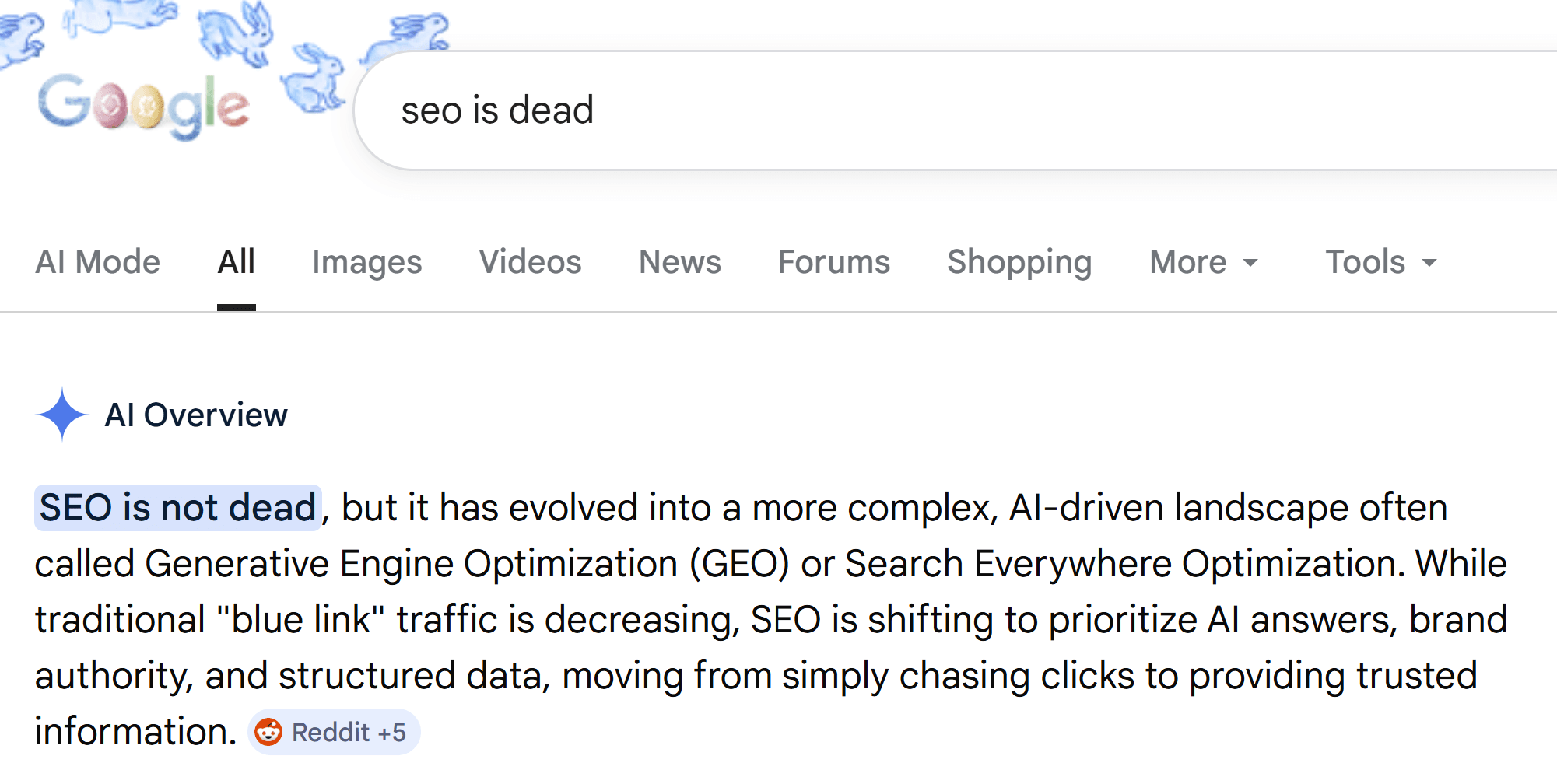
Having these thoughts are not surprising, since alot of people are feeding the flames of this fire! A quick search for “SEO is Dead” shows tens of millions of results!
The evolving story is that Google AI overviews and LLM tools like ChatGPT, Claude and Perplexity are eating up your organic traffic. Since AI is answering your potential visitor’s questions right in the search results, it’s leading to zero clicks to your website. This is known as the new ‘zero click search marketing’ landscape.
Major information-based organizations have reported significant drops in organic traffic, with a global reduction of 33% year over year (Reuters, Chartbeat 2026).
So what is a funding-starved Nonprofit to do if SEO is failing for the ‘big guys’?

Why big-site traffic drops don't apply to your nonprofit
The organic search losses for big e-commerce and news media sites are real.
But are these results relevant to YOUR nonprofit?
Do you have the same mission, goals and purpose as these large media or e-commerce organizations?
Do your clients, donors, volunteers and partners have the same needs and wants as the target audiences for these large organizations?
Much SEO advice and discourse refers to product or service-based for profit organizations who are trying to do two things – sell something and make a profit. Thus the SEO, AEO or GEO advice can miss the mark, and frankly be off the charts for a small to medium sized nonprofit looking to grow awareness, create leads and attract donors in niche areas.
What Google Says about SEO in 2026
White hat vs. black hat: why good SEO was never about tricks
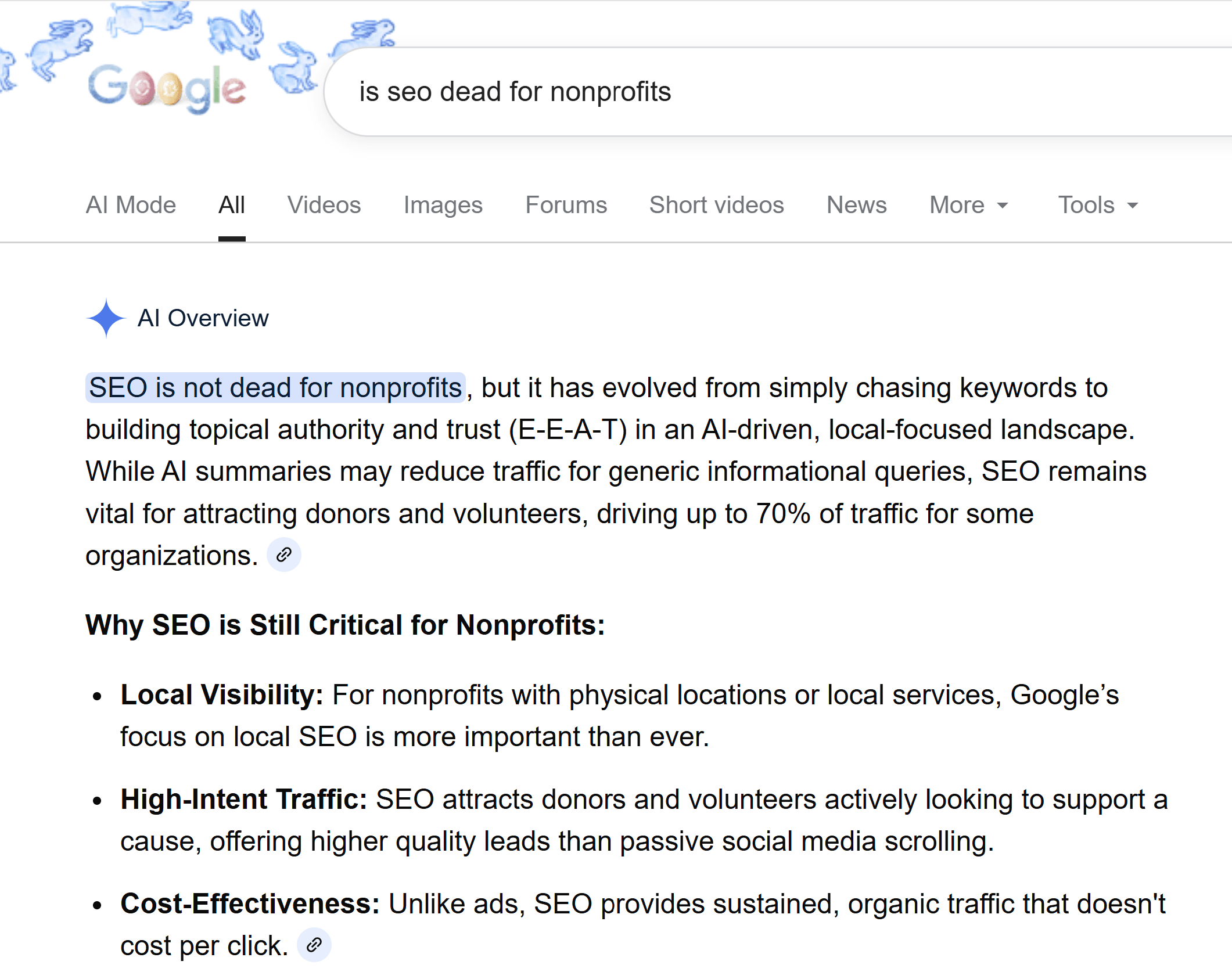
Google’s own AI Overviews, called ‘the death of SEO’, report that “SEO is not dead” and “SEO remains vital for attracting donors and volunteers“, while adding it is evolving from just chasing keywords to building trust and topical authority.
The key phrase here is ‘just chasing keywords’ which is a very limited approach to SEO indeed. Those who primarily used tactics like ‘keyword stuffing’, buying links or publishing content at scale were at best inexperienced, or at worst, practicing Black Hat SEO.
Black Hat SEO is widely viewed as an unethical approach to SEO that can deliver quick results but more often causes long-term damage after Google roots you out and penalizes your site.
The main goal of ‘good SEO’ has always been to provide quality content and online experiences that resonate and build trust with your intended audiences on a well-performing website that is also technically sound and crawler-aware. SEO that works on these principles is known as White Hat SEO.
With recent AI advancements and regular Google Core Updates, the Black Hat SEO gig is increasingly up.
If anything is dying with SEO, it’s the Black Hat approach.
We've seen tech panic before — here's what actually happened.
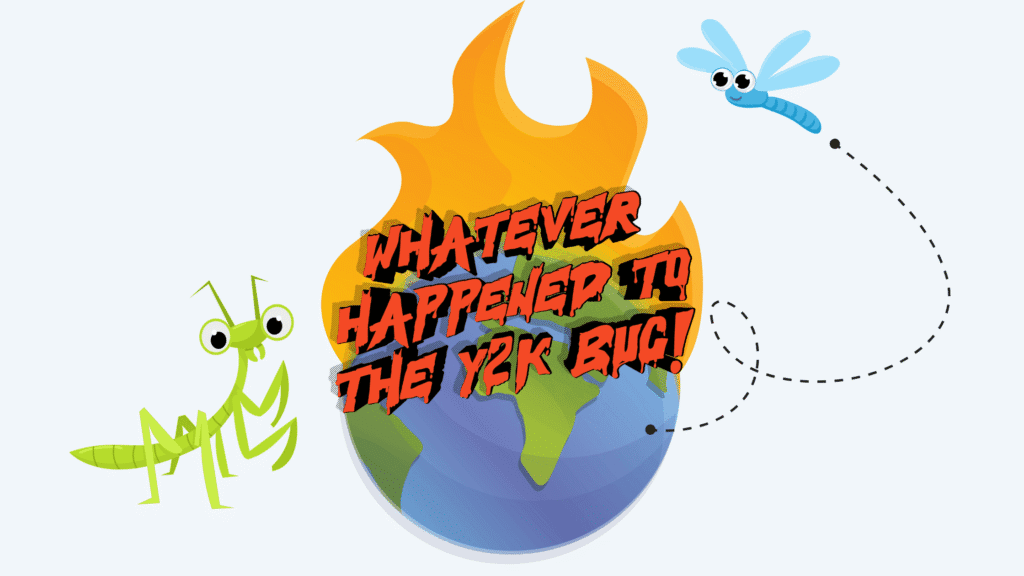
I’ve watched a very similar technology panic cycle play out before, and it ended up quite differently than the doomsayers predicted.
Some of you may remember the Year 2000 Bug – the end-of-the-world global technology failure that came and went with a whimper?
I certainly do – that is how a summer student and English major like myself, hired to fix 10’s of thousands of lines of code with 2-digit years became a computer programmer, fixing and learning from the code as I went.
With my new-found skills and passion for programming, I moved on to desktop application development in the late 1990’s, designing and building automated Microsoft Office solutions, applications that were supposed to be the end of skilled white collar workers everywhere.
AI has revived the fear of being obsolete again.
Yes, some jobs did become obsolete.
But what ALSO happened was that new jobs, skills and opportunities arose. Clients and employees benefitted greatly from developing new skills and working with time-saving solutions that automated low-value repetitive office work.
How are the events around the Year 2000 Bug relevant to nonprofits and small businesses current needs around search visibilit?
The parallel I see from Y2K and AI-maggeddon, is the explosion of doomsday prophets and goldrushers trying to create, enflame and profit on fear.
How AI Search Is Changing Nonprofit SEO
SEO, GEO, AEO — what's actually different?
If you’re new to some of the terms flying around these days, here’s a quick primer.
SEO (Search Engine Optimization) is the established practice of making your content findable on Google, Bing and other search engines through technical soundness, quality content, and authority signals. More recently, with the advent of many AI chatbots, SEO is becoming known as “Search Everywhere Optimization”.
GEO (Generative Engine Optimization) refers to optimizing content so that AI tools like ChatGPT, Perplexity, and Google’s AI Overviews cite or summarize it in their responses. GEO is a new term, but its underlying principles – trustworthy, well-structured and authoritative content – are the same as SEO.
AEO (Answer Engine Optimization) focuses specifically on getting your content to directly answer questions, whether in Google’s featured snippets, voice search results, or AI-generated answers. Again, the practices with AEO overlap heavily with good SEO.
As nonprofit managers, you don’t need three separate website content and digital marketing strategies for SEO, AEO & GEO, but you will need more tools in your tool box.
One well-executed people-first nonprofit content strategy covers all three.
Why people-first content still drives nonprofit visibility
The good news is that for mission-focused Nonprofits, if you already have great content trusted by Google that is created BY humans FOR humans including community-centric stories speaking to your audience’s questions and needs, you’re in good shape.
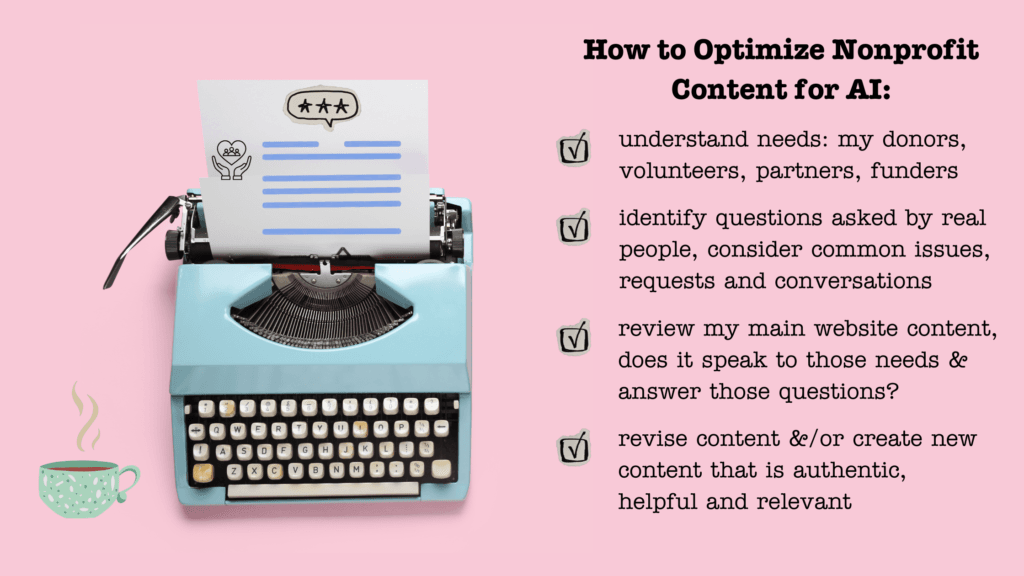
Understanding and answering your audience’s questions and needs is not a new form of SEO or ‘Answer Engine Optimization‘ (AEO) as some are calling it – it’s just plain common sense and basic business and marketing know-how.
Google has long provided very clear direction for creating high quality, high visibility content. Their self-assesment criteria in the “Creating helpful, reliable, people-first content” documentation on Google Search Central, should be a part of every online Content Strategy bible.
The search landscape and search numbers are changing fast, but Google still dominates online search over ChatGPT by far, which is for now, the most popular AI tool. We can still rely on Google Search for a while, and no doubt they will find a way to continue to be relevant as the market leader.
Google specifically advises to “avoid creating search-engine first content“, so be wary of following advice too closely that claims to ‘beat’ the algorithm – see the recent downfall of the popular self-promtional “listicles” tactic.
Take it straight from the source – create authentic, trustworthy “people-first” content that answers the questions and needs your intended audiences have, and host it on a fast-loading, technically sound website.
Google's May 2026 guidance: You don't need to rewrite your site!
On May 15, 2026, Google released new guidance on optimizing your website for AI and generative search.
In this guide they assert the continued relevance of SEO, and go as far to say that AEO & GEO is “still SEO”.
Google’s John Mueller, Senior Search Advisor also affirms that “SEO best practices remain relevant and foundational to success with our generative AI features” in his post announcing the release of this new guide.
For nonprofit website managers, you can breathe a sigh of relief: Google confirms that there is no need to rewrite your website for generative AI search.
Here’s a quote of their statement in the “Rewriting Content for AI systems” section:
“You don’t need to write in a specific way just for generative AI search. AI systems can understand synonyms and general meanings of what someone is seeking, in order to connect them with content that might not use the same precise words.“
Two Nonprofit SEO Strategies: Content vs. Local
Content SEO is Essential for Nonprofits With a Regional or National Focus
As already established, the quality of your content is STILL critical for showing up in online search results, AI overviews and AI LLM tools. “Good” seo-optimized content is more of a strategic advantage if you are trying to build awareness, educate or build trust across larger geographies.
Uniquely implementing a content strategy that addresses larger social issues or questions, may put you on the same page (pun intended) as much larger and better funded organizations with significantly more ‘brand authority’.
AI Overviews and LLMs seem to favour trustworthy high search-intent content over brand authority, so there’s a HUGE opportunity for small nonprofits to claim AI citations for high intent searches for the issues you are trying to solve.
Local SEO for nonprofits: Google Business Profile and Maps
If you are looking to make an impact locally, increase foot traffic or service usage and attract local clients, volunteers, partners and donors, maximize your Google Business Profile, Google Maps presence, social media presence, local partnerships & collaborations and verified reviews.
Demonstrating that actual humans trust your organization goes a long way in building authority within Google’s algorithms and platforms, both for organic search and paid search via Google Ads.
Since most major AI LLMs still rely on Google’s indexing data and infrastructure, along with proprietary data, websites and social media globally including yours, if you continue to build valid trust factors in your digital online presence you will be on a solid base for AI search.
How good SEO improves your Google Ad Grants performance
Let’s face it, SEO is just one factor in your digital marketing strategy. Social media, YouTube, email campaigns, Google Ads and multiple paid marketing platforms may also be in your marketing stack.
Although Google Ads doesn’t have an “SEO score” for a landing page, it does have a “Quality Score” for how well a landing page meets the intent of the intended audience, the selected keywords and how well the page performs, based on Google’s E-E-A-T principles.
Good SEO enhances your landing page quality and relevance which can significantly improve the performance of your Google Ads and Google Ad Grants campaigns. In my practical hands-on experience providing nonprofit SEO & digital marketing services, I also specialize in Google Ad Grants for Nonprofits. Improving a keyword’s Quality Score in a Google Ad Grants campaign using traditional SEO practices on the landing page can significantly increase your impressions and conversion rates – although the impact is indirect, it is real and measurable.
Stay tuned for my case studies showing the impact of SEO on Google Search Ads performance.
Having a well-structured, topically organized and people-first, crawler-aware SEO-optimized site is also a great help in determining the best Google Ad Grants strategy for your nonprofit organization. Having a clear, relevant, well-performing site will help you in the application and approval process as well.
Nonprofit SEO Action Plan: 7 Steps to Get Visible
First off, don’t panic.
You don’t need to abandon your traditional SEO strategy (unless it’s Black Hat), BUT DO incrementally adapt to AI Search with incremental changes based on your own data, research and monitoring.
If you are just starting out with your Nonprofit SEO strategy, the following recommendations will also serve you well.
Research Keywords Your Audience Actually Searches
Start by listing the programs, services, and issues your audience cares about most, then use free tools like Google Search Console, Google's "People also ask" boxes, or Google Ads Keyword Planner to find the actual words and phrases they type into search. Pay attention to search intent: a donor searching "how to support youth mental health programs" has different needs than a volunteer searching "volunteering near me." The goal isn't to guess what people might search, it's to confirm it with data, then create content that directly answers what you find.
Create People-first Content
Focus your content on your mission, genuine expertise, authentic experiences - create people-first content written by humans that answers real questions and needs. You know the needs of your audience (and if you don’t, start the conversation) - write content that speaks to them.
Ensure Your Content is Not Too ”Thin”
Important programs, projects or services should have their own landing pages with in-depth relevant content, images, video and testimonials or reviews where relevant and possible
Build Your Backlinks through Relationships
Backlinks are hyperlinks to your site, from other external websites that help build your online authority in the 'eyes' of search crawlers and agents. Build your credibility and backlink profile through valid online partnerships and community engagement - collaborate on social media, YouTube and with your website content, including topical links between you and your partners’ websites or platforms. Relationships are key - Buying links with Black Hat SEO tricks are out.
Build Local Credibility
If you have a local audience - treat your Google Business Profile and Google Maps as your “digital storefront”. Take advantage of all opportunities here to promote your programs, events and services and be sure to include links back to specific and relevant pages on your website.
Provide People & Crawlers With a Good User Experience
Do make sure your website loads quickly, especially for mobiles. Ensure there are minimal errors. Include content that crawlers and people like, for example a FAQ page or sections on your website that answer the most common questions people ask or the most common needs they have.Make sure your donation pages, sign-ups forms, newsletters and other types of lead generation and user engagement are functioning well and are user-friendly.
Monitor Your Search Visibility
Test out Google and Bing Search yourself, and ask ChatGPT, Claude and other LLM tools questions that you believe your website should receive citations for. Bing Webmaster Tools is now showing AI citations and Google Search Console AI performance reports should not be far behind, so reconsider forking out the big bucks for the latest AI Tracking tools - unless you really want to.
The Bottom Line - Nonprofit SEO Still Works: If You Do It Right
AI is 100% reshaping search.
It’s real, and it’s significant… it’s definitely worth paying attention to.
However, for small to medium-sized Nonprofits and non-e-commerce or media sites, this is not an AI Apocalypse. There’s certainly no need to hand your budget over to whomever is shouting the loudest that “SEO is Dead” and that you must re-tool everything, trying to provoke and capitalize on fear.
The name “SEO”, may change. It may become GEO or AEO or “Search Everywhere Optimization” or something else, but at the end of the day, if you are trying to reach people, you still need to write for and market to, people. The technology that delivers your content to people, will always be changing.
Stay grounded in what works for people: genuine content, adapting to technical basics, and a clear understanding of your audience.
Monitor your performance and adapt where the data actually shows you need to.
Do you have questions about where your nonprofit actually stands with SEO (or GEO or AEO)?
Get in touch — I’m happy to do a free nonprofit SEO assessment, no strings attached.
This article was written by a human with practical experience and knowledge using traditional online research and AI tools Claude and Perplexity for research and fact-checking.

